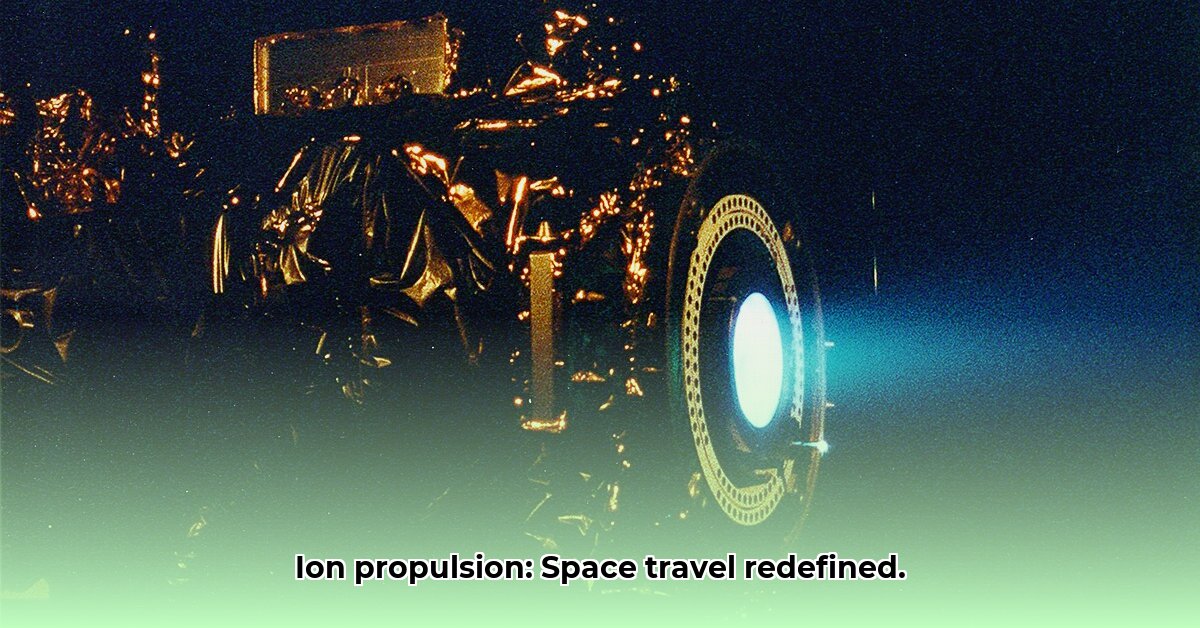
Ion Propulsion Satellite Technology: A New Era of Space Exploration
Imagine a tiny engine, smaller than a microwave, capable of propelling spacecraft to the Moon and beyond—faster, cheaper, and more frequently than ever before. That's the remarkable promise of NASA's H71M ion thruster, a revolutionary advancement in ion propulsion satellite technology. This isn't merely a technological leap; it's a paradigm shift in how we explore the cosmos. Learn more about space exploration advancements at this revolutionary site.
Forget the thunderous, fiery blasts of traditional rockets. While powerful, they're essentially short bursts of energy—like sprinters in a race. The H71M, however, is more akin to a marathon runner. It delivers a steady, sustained push over extended periods, making longer missions not only feasible but also significantly more economical. This sustained thrust enables incredibly precise maneuvers in space, crucial for reaching distant destinations like Mars. Isn't it remarkable how a small change can have such a large impact?
The H71M: A Tiny Engine, a Giant Leap
The H71M's compact size is no accident; it's the result of brilliant engineering. NASA cleverly adapted technologies initially designed for the planned Lunar Gateway space station. This exemplifies how innovation in one area can rapidly accelerate progress in others. This efficient approach saves money and accelerates development. This "technology transfer," as scientists call it, showcases NASA's commitment to finding clever, cost-effective solutions.
This miniaturization is paramount. Smaller engines translate to lighter spacecraft, resulting in substantially lower launch costs. We're talking about the potential for multiple missions per year instead of one every few years, dramatically increasing the pace of space exploration. How many more discoveries await if we can launch missions more frequently?
Why Ion Propulsion is So Awesome
Before delving deeper into the H71M, let's briefly discuss ion propulsion itself. It's a fundamentally different approach to spacecraft propulsion compared to traditional chemical rockets. Instead of burning vast quantities of fuel to generate thrust, ion thrusters use electricity to accelerate ions (electrically charged atoms) to incredibly high speeds. This creates a gentle but persistent push that, over time, builds up to tremendous velocity.
Think of it as a gentle breeze that, consistently applied, can still propel a large sailboat across an ocean. The benefits are substantial: incredibly efficient fuel use, longer operational lifespan, and the ability to make minute, precise adjustments to a spacecraft's trajectory.
The H71M's Advantages: A Closer Look
The H71M excels in several key areas:
- Blazing Speed: It achieves the high speeds necessary for deep-space travel, making previously impossible missions suddenly attainable.
- Budget-Friendly: The ability to launch more frequently directly translates to lower mission costs.
- Built to Last: With a projected lifespan exceeding 15,000 hours—that's over six years of continuous operation—the H71M is designed for long-duration missions.
- Precise Maneuvering: This is vital for accurate space navigation and docking procedures with other spacecraft or celestial bodies.
Challenges and the Road Ahead
While the H71M is groundbreaking, challenges remain. One is its propellant mass fraction—the proportion of the spacecraft's mass dedicated to fuel. While improved compared to older ion thrusters, it might still limit ultra-long missions. Ongoing research focuses on enhancing efficiency and optimizing the thruster for various mission profiles and spacecraft designs. Further miniaturization and scalability are also crucial areas of ongoing development.
Looking Forward: A Collaborative Effort
The future of the H71M and ion propulsion technology hinges on collaborative efforts. Here's a glimpse into short-term and long-term goals:
- Short-Term (0-1 year): Extensive testing to validate the H71M's performance.
- Long-Term (3-5 years): Integrating the H71M into lunar and Martian missions; developing higher-thrust versions.
Navigating the Risks: A Proactive Approach
Potential risks associated with the H71M include technological malfunctions, supply chain issues, system instability, and spacecraft integration problems. Mitigation strategies include redundancy systems, rigorous testing, diverse suppliers, robust design, comprehensive environmental testing, and thorough integration testing.
The Legal Landscape: Responsible Space Exploration
Successful deployment of the H71M mandates careful consideration of international space law, including regulations concerning space debris and responsible space utilization. As space traffic increases, new regulations may emerge.
Conclusion: A Brighter Future in Space
The H71M represents a monumental leap forward. However, this is just the beginning. Continued research and development will undoubtedly lead to even more impressive advancements in ion propulsion technology, opening doors to ambitious missions to the Moon, Mars, and beyond. The future of space exploration is electric, and it's incredibly exciting!